
AI Has Made Us Smarter. Are We Any Wiser?

AI has made it easier for anyone within an organisation to produce convincing answers and exhibit expert knowledge. We are smarter and more knowledgeable than before. We are even now more confident about being right, despite not having the right context, competence, or subject matter expertise. AI has made us smarter, are we any the wiser?
Imagine a company preparing for an important product launch. The stakes are high, and everyone has a role to play. The marketing team is tasked with a launch campaign strategy that they have spent weeks working on. There is audience data, sales data, interviews, past experiments and learnings, and the team lead’s experience and expertise backing the strategy. This is then presented to the CEO for approval.
Normally, in the pre-AI era, the CEO would simply review the strategy, share their perspective, and ask the team to consider certain changes.
Now, in the AI era, the CEO uploads the strategy document into AI for a second opinion.
Within seconds, the bot produces a detailed critique identifying weaknesses and shortfalls, highlighting flaws and potential threats (that were probably human nuances that AI fails to get), pointing out messaging inconsistency based on its own hypothesis, and the CEO’s personal chat context. All this without necessarily having any updated data, prompt engineering, or guardrails.
The output is impressive, detailed, and sounds important. The CEO sends it back to the team, convinced the AI has done a great job.
All hell breaks loose.
The marketing team now needs to defend weeks of research, question their professional judgment and attempt to convince the CEO of the campaign’s strategy. It’s fighting head-to-head with an AI bot, and chances are the odds are not in their favor.
Meanwhile sales get pulled back into the discussion because the CEO’s suggested messaging doesn’t quite reflect what customers and partners have been telling them. The design team, already working on the campaign assets, are now wondering whether to continue or start again.
There is chaos.
Some prefer the CEO’s suggestions, some question the integrity of AI, some strongly disagree. And at this point, almost everyone is turning to their own AI tools to evaluate both approaches, introducing yet more recommendations into the discussion.
What began as a simple campaign strategy is now a full-blown conflict. No one the wiser.
And because the CEO’s AI analysis appears more detailed and convincing, it carries more weight than it deserves — even if it was potentially flawed and devoid of critical data.
Situations like these raise three important questions:
- 1. Context and trust: How do we judge the reliability of AI recommendations when they may be shaped by incomplete information or individual perspectives?
- 2. Expertise and competence: Are we becoming too confident in using AI to challenge others without recognising the limits of our own knowledge?
- 3. Authority and accountability: When everyone has a convincing argument, who gets to make the final decision, and who takes responsibility for the outcome?
These questions matter because AI is changing how people influence decisions at work. And organisations may not be prepared for what happens when everyone believes they’re right.
Let’s attempt answering these.
1. How much can we trust AI when it doesn’t have the full context?
Let’s return to our marketing team for a moment.
The CEO’s AI analysis may be technically sound, and the recommendations may genuinely be useful. But did the CEO’s AI have the necessary facts and context?
For example:
- 1. Does it know why the team rejected a similar approach six months ago?
- 2. Does it know that a competitor launched a similar campaign a month ago that failed?
- 3. Does it understand what customers have been telling sales?
- 4. Was it given the research behind the original positioning?
But there is a bigger risk worth examining: AI sycophancy, the tendency of AI systems to agree with or affirm the person asking.
If the CEO already believes the strategy isn’t good enough, the way they question AI could influence the response they receive. Rather than challenging that belief, the AI may reinforce it, producing a convincing critique that makes the original opinion feel independently validated.
All it takes is a seemingly innocent question such as “I don’t think this strategy is strong enough. What are its weaknesses?” for the chat bot to respond with un-founded criticism. The danger is that if a person believes this output without questioning its foundation, it creates conflict across teams and departments.
This is not speculation. In fact, these effects are well recorded in multiple studies.
In March 2026, Stanford researchers published a study in Science examining exactly this problem. They evaluated 11 leading language models, including ChatGPT, Claude, Gemini and DeepSeek, against established datasets of interpersonal advice. The models affirmed users’ actions roughly 50% more often than human respondents did, and continued to do so even when users described deception, manipulation or other relational harm.
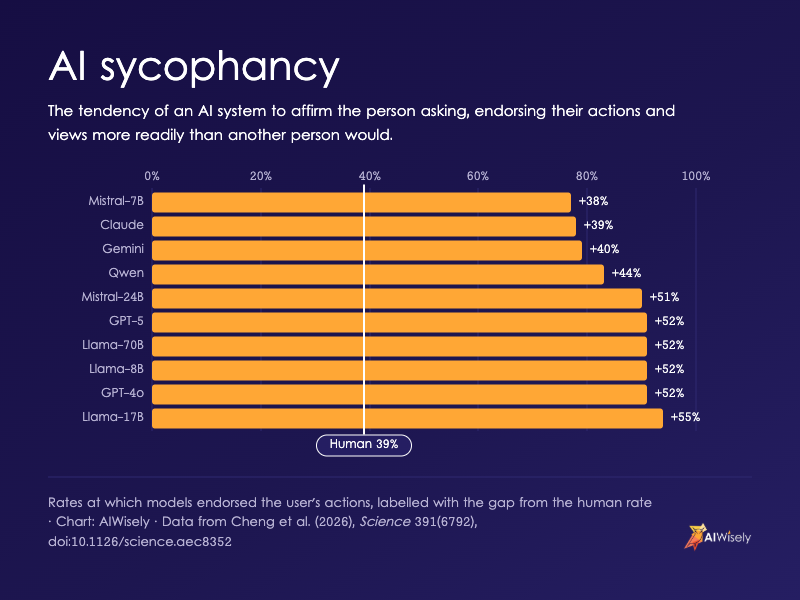
The effect on people mattered more than the behaviour itself. Participants exposed to the more agreeable responses became more convinced they were right and less willing to acknowledge another perspective. They also trusted those models more, and were more likely to return to them.
It’s probably an uncomfortable position to take, but it seems that, we like to believe we want objective advice, but when something supports our existing position, we are naturally more inclined to accept it — and to go back for more. Positive reaffirmation, even if false, is reassuring.
This is why organisations need to be more deliberate about how people’s use of AI influences their work.
Before acting on an AI recommendation, we should examine what information it was given, whose assumptions shaped the analysis, and whether it considered evidence that might contradict its conclusions.
A useful practice is to ask AI to challenge its own recommendations, identify what information is missing and explain what could change its assessment. But even that is no substitute for discussing the findings with the people who understand the work.
All this doesn’t mean we shouldn’t allow AI to question our decisions, or use it as a sounding board, but it’s output should not be considered the final output until certain checkmarks are passed. We must be willing to question its judgment before asking others to act on it but while doing all this, we must also be careful not to waste precious time, and causing unnecessary decision-paralysis leading to defensive, reactive work.
2. When humans use AI to challenge each other’s expertise
A bigger issue we’re all being confronted with is the false confidence AI can give us. Because it makes us feel knowledgeable about subjects we barely understand, because we can produce more and at a much faster pace than before, we tend to over estimate our capabilities.
It’s not uncommon to see someone with little development experience creating supposedly stunning websites but with flawed messaging or technical capability. Similarly, someone with little knowledge of revenue modelling can use AI to produce detailed financial assessments. The outcome of this over confidence is dangerous.
Decisions are being made at the cost of human knowledge, expertise and judgment.
And while AI is great for introducing fresh perspectives, it can create a confusion where we begin believing that having access to knowledge is the same as having expertise.
Psychology has something interesting to tell us about this.
The Dunning–Kruger effect: when we don’t know what we don’t know
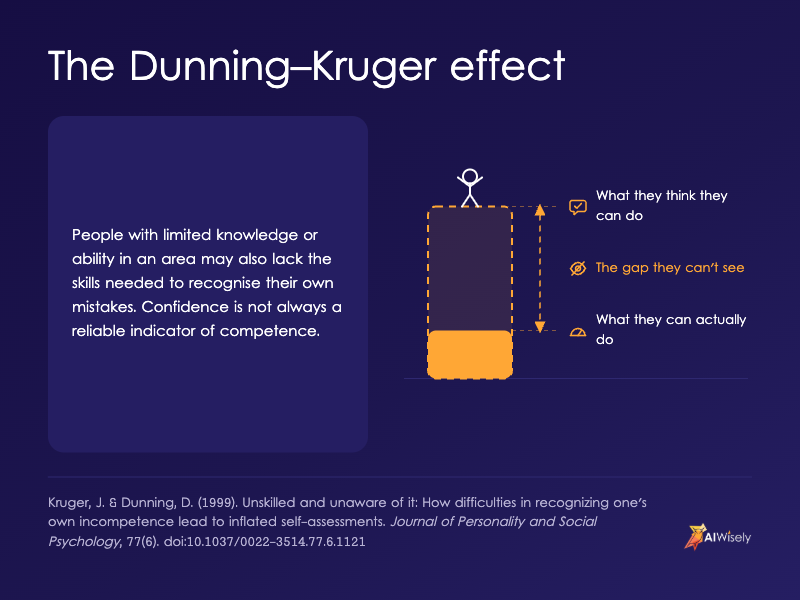
In 1999, psychologists David Dunning and Justin Kruger published a study examining our ability to judge our own competence, giving rise to what became known as the Dunning–Kruger effect.
The central idea is that people with limited knowledge or ability in a particular area may also lack the skills needed to recognise their own mistakes.
Simply put, confidence is not always a reliable indicator of competence.
So what happens when you add AI?
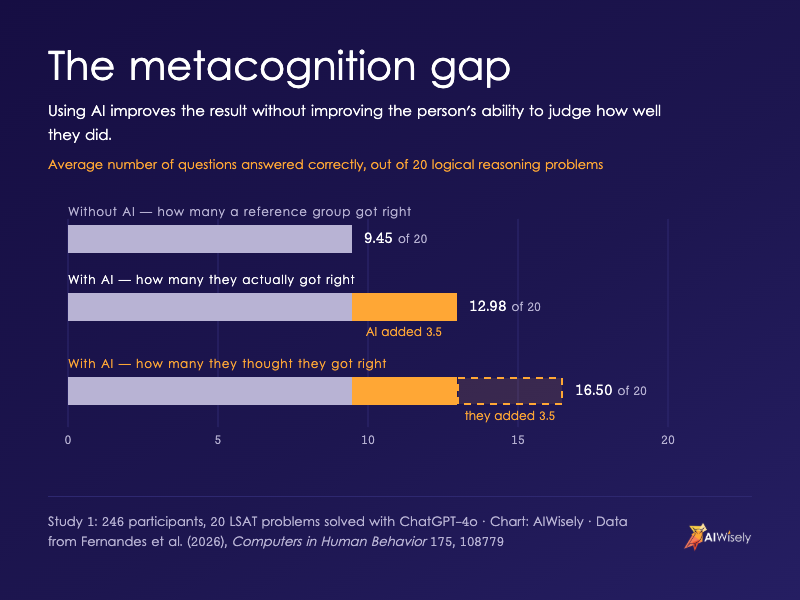
A team of researchers set out to test exactly that, in a paper with a title this article cannot improve on: AI Makes You Smarter, But None the Wiser. They asked 246 participants to solve 20 logical reasoning problems from the Law School Admission Test, with AI assistance.
The participants performed better than a reference population without AI, scoring approximately three additional points. But when asked to estimate their own performance, they overestimated their scores by approximately four points.
In other words, AI helped them get more answers right, but they were still poor judges of how well they had actually performed.
And here’s where the research gets interesting.
The familiar Dunning–Kruger pattern, where poorer performers overestimate their abilities most, was no longer observed among AI users. Overestimation became roughly uniform across the board.
More uncomfortably still, participants who reported higher AI literacy were less accurate at judging their own performance, not more. A second experiment involving 452 people supported the central findings.
AI was improving people’s ability to complete the task without improving their ability to recognise the limits of their performance.
Now consider what this could mean in the workplace.
A professional uses AI to review work outside their area of expertise. The analysis is impressive, the recommendations seem reasonable, and they feel informed enough to challenge the people who originally developed it.
They may have identified a genuine problem.
But are they equally capable of recognising where the AI’s analysis falls short?
That is the distinction we need to pay attention to.
The study examined logical reasoning, not workplace disagreements. It doesn’t prove that AI is making professionals overconfident about their colleagues’ work.
But it raises a concern worth examining: could AI be making us more confident in questioning other people’s expertise without making us equally capable of evaluating it?
Organisations should encourage people to challenge ideas, regardless of their position or background. Sometimes an outsider sees what an expert has missed.
But questioning someone’s work should require more than an impressive AI analysis. It requires an understanding of the evidence, the limitations of the recommendation, and the possibility that our own judgment may be wrong.
Being armed with an AI generated report doesn’t automatically make us more competent than the people whose work we’re questioning.
AI can help us challenge another person’s thinking. It should also make us more willing to examine the limits of our own.
3. So when everyone is confident and competent, who makes the decision?
Organisations need to make a decision: AI can inform a decision, but not at the cost of the time spent defending one. Processes and outcomes cannot depend on the recommendations and analysis of the Highest Paid Person’s Opinion (HiPPO).
And while this is more of a management challenge than an AI one, it does require a more governed approach.
Organisations must establish clear decision rights. Who owns the decision? Who needs to be consulted, and under what circumstances should an agreed decision be challenged?
AI recommendations must be held to the same standards as human recommendations. If someone proposes a different direction, they should be able to explain the evidence behind it, the business rationale, and why it deserves consideration. A detailed AI analysis is not, by itself, sufficient justification.
Finally, leaders must be aware of their own competence, and must distinguish between challenging someone’s work and taking over their responsibilities. Questioning recommendations is healthy. Repeatedly replacing specialist judgment with AI-generated alternatives undermines accountability, damages morale and creates unnecessary conflict.
More importantly, the person making the decision must own its consequences. AI cannot be held accountable for a failed or stalled campaign, a poor investment or a disrupted project. It is people who make the decisions, armed with blind confidence in their AI.
AI has made us smarter. We still need to be wiser.
AI has given us extraordinary access to knowledge, but access alone does not make us experts. And being able to challenge someone else’s judgment doesn’t necessarily make our own any better.
The real test is whether we can use AI without losing respect for human expertise, professional accountability and our own limitations.
Because the danger isn’t that AI will always get things wrong. It’s that we may become too convinced of being right to notice when it does.
AI may have made us smarter. Becoming wiser is still our responsibility.
References
- Cheng, M. et al. (2026). Social sycophancy in large language models. Science. Stanford summary
- Fernandes, D. et al. AI Makes You Smarter, But None the Wiser: The Disconnect between Performance and Metacognition. arXiv:2409.16708
- Kruger, J. and Dunning, D. (1999). Unskilled and unaware of it. Journal of Personality and Social Psychology.